


The best feeding positions for newborns will support a good latch
When your baby connects to your breast and creates a seal with their mouth it’s called ‘latching on’. A good latch will help ensure your baby is feeding properly and is often the key to comfortable, satisfying breastfeeding. But getting a good latch can take a little practice for some mums and babies.
The good news is that getting a good latch is a skill you can both learn. Even if you find it challenging at first, you’ll soon get the hang of it with a little patience and practice. If you don’t get a perfect latch the first few times, don’t worry. You soon will. Remember that breastfeeding has lifelong health benefits for your baby so taking a short time now to learn to latch is well worth it. Follow these top tips to get ready to breastfeed your baby, then check your positioning against the illustrations below:
1. Tickle
When your baby is at your breast and ready to eat, tickle their lips with your nipple until their mouth is wide open.
2. Cuddle
Bring your baby close to your breast (rather than moving your breast towards them) and make sure their chin and lower jaw touch your breast first.
3. Position
Your baby’s lower lip should be far away from the bottom of your nipple. This is because you want them to take a large mouthful of your breast, not just your nipple.
Six signs of a good latch
- You feel comfortable. A good latch means comfort for you. It shouldn’t pinch or hurt.
- You’re chest-to-chest. Your baby’s chest should be pressed against your body so they don’t have to turn their head to feed.
- Your baby’s mouth is filled with your breast. Their chin and nose are touching your breast and their tongue is cupped underneath.
- Your areola is completely (or almost completely) covered. If your baby has a large enough mouthful of breast, you should see little or no areola (depending on its size). If you can see some areola, you should see more of it above your baby’s lips and less below.
- Your baby’s lips look like ‘fish lips’. Your baby’s lips should be turned out (like a fish) rather than turned in. You may not even be able to see their bottom lip.
- You can hear your baby swallow. Some babies will swallow loudly while others will fee quietly. If you can’t hear them, check to see if their ears are moving slightly. If they are, your baby is swallowing.
Best feeding positions for newborns
It may take a while to find out what works best for you and your baby. Success takes practice and proper positioning. After you experiment with different breastfeeding positions, you’ll arrive at what’s most comfortable for both of you. You might like to change positions to help adequate and uniform draining of each breast. Check out these four tried-and-tested optimal breastfeeding positions that help you both relax and encourage your baby to latch on well. Which one works best for you?
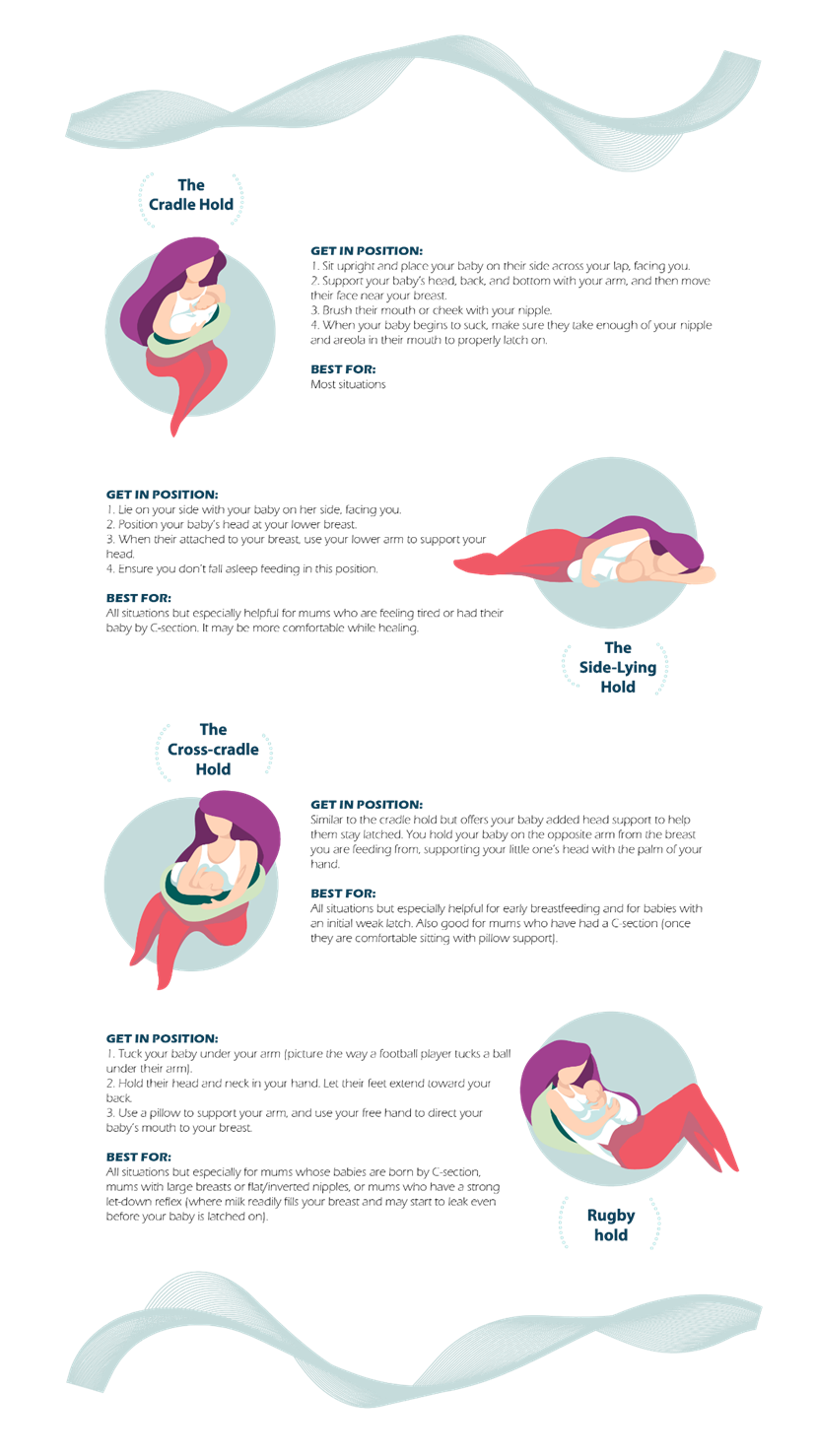
Best feeding positions and locations
Your baby will most likely be more settled, and older babies will be less distracted, when feeding in a quiet place. Breastfeeding your baby is a normal and natural thing to do and it is your legal right to be able to feed your baby when and where ever you feel necessary. Most mothers work out where and how they can feed their babies when they are out, so that they are comfortable. If you feel uncomfortable or self-conscious when breastfeeding in public, drape a light muslin wrap over your shoulder so it covers your breast and baby. Some common relaxed locations to breastfeed comfortably include:
- Home: Your living room or bedroom can be the most comfortable places to feed, allowing you to relax in your own space.
- Quiet cafés: Many cafés have cozy corners where you can enjoy a warm drink while feeding your baby.
- Parks: Find a shaded bench or a quiet spot on the grass where you can enjoy nature while breastfeeding.
- Parenting rooms: Many shopping centres have dedicated parenting rooms equipped with comfortable seating and changing facilities, making them perfect for breastfeeding.
- Libraries: These quiet spaces often have comfortable seating areas that can provide a peaceful environment for feeding.
- Friends' homes: Visiting friends who understand your needs can create a relaxed atmosphere for breastfeeding.
- Car: If you prefer privacy, your car can be a great spot to nurse, especially when parked in a quiet area.
Remember, the key is to find a location where you feel comfortable and at ease. This not only helps you relax but also creates a calm environment for your baby to feed.
Frequently asked questions about breastfeeding positions
What is latching?
Latching is when a baby attaches to the breast to feed, ensuring they get milk effectively.
How to latch a newborn?
To latch a newborn, hold them close, support their head, and guide them to your nipple, aiming for a wide mouthful.
How to get a good latch?
A good latch means your baby’s mouth covers more than just the nipple, with their lips flanged out and chin touching your breast.
What not to do during breastfeeding?
Avoid slouching, using harsh soaps on your nipples, and letting your baby fall asleep without a full feed, which can affect milk supply.
Breastfeeding hurts a bit! Is that normal?
Some tenderness and even pain in the beginning isn’t unusual but over time, once you and your baby have mastered this skill, you shouldn’t be feeling pain. Check your baby is taking a large mouthful of breast – sucking on just your nipple can cause discomfort. If this happens, break your baby’s suction by gently putting a clean finger into the corner of their mouth. Then tickle their lips, and encourage your little one to latch on properly, again.
I’m not sure my baby’s sucking when they feed. Could they have a weak suck?
If your baby is not latched on properly, they might not be able to remove milk from your breast when breastfeeding. If you feel your baby is latched on correctly but still feel that their sucking is weak or wonder if they’re getting enough breast milk, talk to a lactation consultant or healthcare professional.
My baby is getting frustrated… and so am I! What can we do?
Might be easier said than done, but try to relax. Take a deep breath, have a little break then try again. You might want to try another breastfeeding position or try some skin-to-skin contact by placing your little one on your chest. Soothe them by talking calmly or singing. When a baby is hungry, they will open their mouth and search for the nipple. If your little one begins to cry and get agitated, it may be because they are frustrated and hungry. Once you’re both comfortable, calm, and relaxed, try latching on again. Remember that practice does make perfect. Be patient with yourself. You’re doing a great job!
My breasts feel very full and my baby’s having trouble latching on. What can I do?
You could try expressing a little milk by hand or pump before you breastfeed. This will relieve the pressure and soften your breasts so your baby can latch on. Overfull breasts are sometimes called ‘engorged’. If you feel your breasts are engorged between feeds, breastfeed or pump every two hours for relief. Remember, your newborn baby should be breastfed at least 8 to 12 times every 24 hours.
Sources:
Raising Children Website. Accessed at How to breastfeed: breastfeeding positions | Raising Children Network
Related articles

Breastfeeding is nature’s intended way to feed a baby and the health benefits of breast milk and the benefits of breastfeeding are evident for baby and mum.
6 mins to read

How Often does a Newborn Feed?
The first few months in particular you will notice huge changes in your baby’s growth and development; there is truth in the cliché ‘they grow so quickly’.
5 mins to read

Newborn babies are often very alert and eager to feed right after birth. Straight after birth you produce this special substance called colostrum, which is full of infection-fighting antibodies.
13 mins to read
Related tools

Want to keep track of your child’s growth? Log the weight and height of your child from birth to 3 years of age. The perfect resource for your next healthcare professional checkup.


